Ask any exhibit house what’s changed most in the last year, and AI comes up fast. Concept renderings that used to take days now show up in an afternoon. Activations that once relied on screens and scripts can now generate something unique for every visitor who walks up. It’s a genuinely exciting moment for this industry. It’s also created a new kind of problem.
More and more, clients are walking into the design process with an AI-generated rendering of their trade show exhibit already in hand — a striking visual built in minutes, full of ambition, and not always grounded in what a show floor actually allows. For many exhibit houses, that rendering becomes either a wall or a letdown: too complex to build as shown, so the concept gets quietly scaled back, or built anyway and falls short of what was promised.
There’s a third option: when an AI-generated concept is paired with experienced design, engineering, and fabrication from the start, it’s possible to get remarkably close to the original vision while still accounting for the realities of building it. That’s the approach outlined below.
What AI Is Genuinely Good At
AI has earned its place in the early stages of exhibit design. It’s fast at generating visual direction — concepts that once took days of sketching now come together in an afternoon. That speed has a real ROI: it shortens the runway between a creative idea and a client decision, which means fewer design hours spent on directions that won’t get approved, and a tighter overall timeline from concept to show date.
That early feedback is valuable on its own. Clients can react to layouts, materials, and messaging long before fabrication budgets or engineering resources are committed — and the earlier that conversation happens, the more options stay open.
It’s also opening up new kinds of attendee experiences. The most interesting AI applications on the show floor today aren’t about imagining a booth — they’re inside the booth, generating something live and personal for each visitor. That’s a different use of the technology entirely, and one we’ll come back to.
Where the Gap Shows Up
Here’s the part that doesn’t make it into most AI demos: a rendering doesn’t know your venue’s fire code. It doesn’t know what a structure needs to span a 30-foot opening without sagging, or what changes when that same exhibit has to ship flat, get installed overnight, and survive five more shows after this one. Most importantly, it doesn’t know your actual budget — a beautiful render can quietly imply a spend two or three times what a client meant to commit.
That’s where experienced exhibit professionals become essential. The difference isn’t better software — it’s understanding how design decisions affect engineering, logistics, installation, transportation, storage, and future program costs. The most successful exhibits aren’t simply visually impressive; they’re designed to work within the realities of an exhibit program. That expertise only becomes more important as AI-generated concepts get more ambitious.
None of this puts the client’s vision in the back seat — if anything, it’s the starting point. The work is making it real, together.
When an AI Rendering Becomes Reality
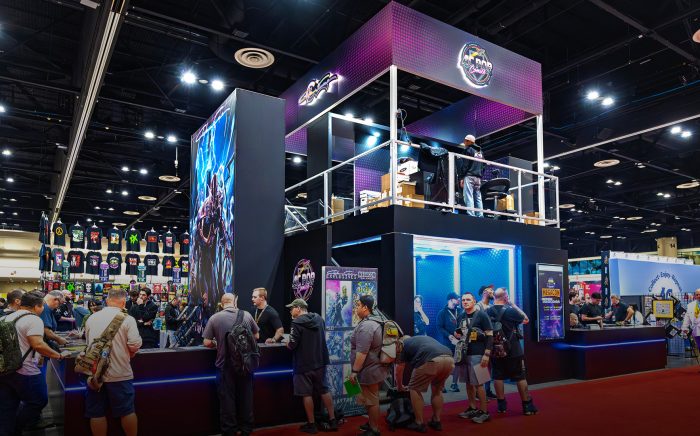
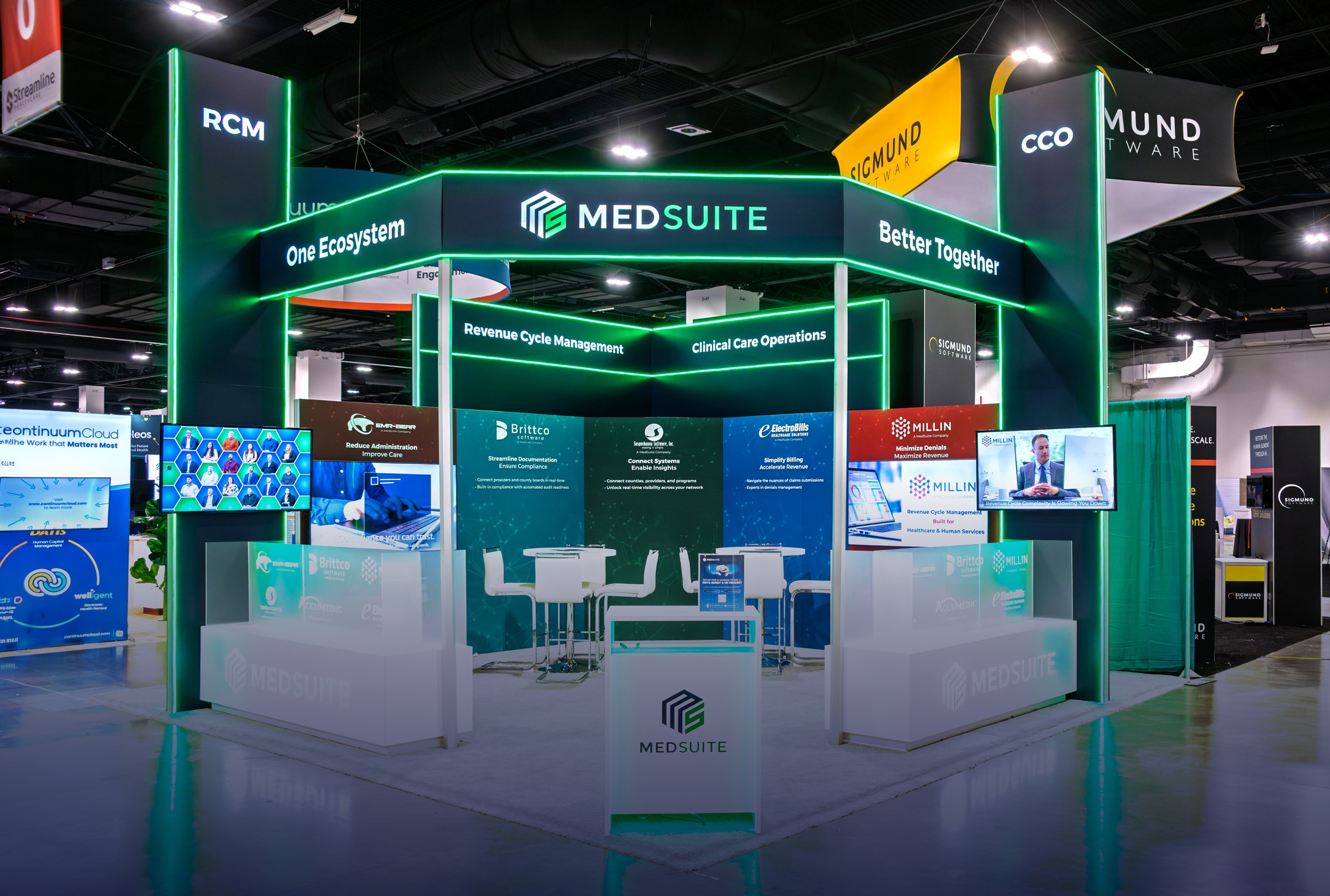
In one recent project, a client brought an AI-generated rendering as the starting concept for their exhibit. The usual path for a concept like this is simplification: features get removed, materials change, and the final build becomes a more practical version of the original idea.
Here, design and engineering worked directly alongside the client from the start, rather than treating feasibility as a later step. Structural questions, material substitutions, and shipping considerations got solved in the same conversation they came up in, instead of getting flagged after the fact.
The finished exhibit matched the original AI rendering almost exactly — not because the technology behind the rendering improved, but because design and engineering treated it as a real blueprint from day one and worked the problem through with the client, rather than scaling the vision down to something easier to deliver.
AI as Part of the Experience, Not Just the Concept
A different project used AI in a completely different way — not as a concepting tool, but as the attraction itself. The client had access to a true generative AI program — not a preset menu of options, but a system that generated something genuinely unique based on attendee input. Attendees answered a few questions, and the program generated a scent created specifically for them, live, on the spot.
The technology itself wasn’t something built in-house. The work was identifying and building the right physical channel to showcase it — the staging, the interaction flow, the booth environment that made the technology the centerpiece instead of an afterthought bolted onto a standard layout.
The AI was powerful. But without the right physical staging, visitor journey, and exhibit design, attendees may never have experienced its full impact.
This is where a full-service exhibit partner earns its place. Whether a client is showcasing proprietary technology, launching a product, or building an experiential activation, the challenge isn’t just the technology itself — it’s creating the environment that lets people interact with it, and guiding the client through that journey from concept to show floor. Sometimes the most important part of an AI-driven experience isn’t the AI. It’s how it’s presented.
The Takeaway
AI is reshaping the exhibit industry in two distinct ways. First, it’s changing how concepts get imagined — clients can explore ideas faster and arrive at the design process with more clarity already in hand. Second, it’s changing what attendees experience live on the show floor, through personalization and generative content that didn’t exist a few years ago.
In both cases, the technology is only as good as the partner who can translate it into something real. A striking AI rendering still needs an engineering team willing to build it as shown, not scale it down. A generative AI activation still needs the right physical stage to land. That’s where the work — and the value of a true exhibit partner — actually lives.
If you’re holding an AI-generated concept — or a piece of technology you want to bring to life on the show floor, contact 2020 Exhibits and let’s talk about what it would take to build it.